

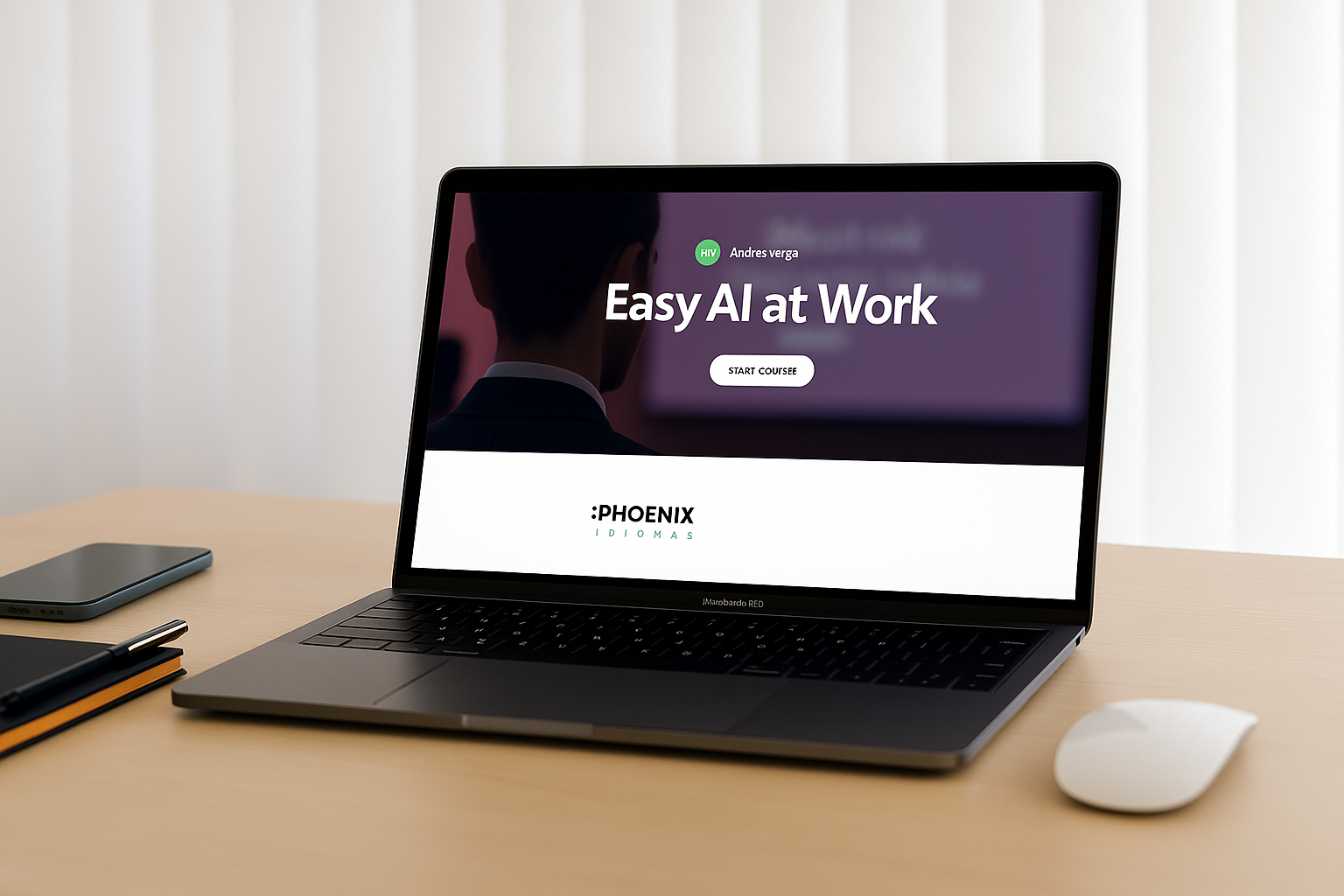
Virtual Instructor-Led Training
My role
Challenge
Deploying a modern, interactive AI course with a minimal budget, no Learning Management System (LMS), and a need to strictly adhere to Fundae administrative requirements.
Solution
I advised embedding Articulate Rise modules directly into WordPress. Using Articulate Rise allowed the client to save money, as I have already possessed a subscription. I established that student progress would be measured via the 25-minute phone sessions and recorded in the existing attendance logs. This satisfied the client’s need for simplicity and the regulator’s need for attendance proof without incurring software costs.
Client
A small, local language academy located in the Basque Country seeking to modernize its curriculum and thus attract more clients.
Industry
Professional Language Training & Education.
Project duration
Rapid development cycle designed to accommodate a minimal budget while addressing an immediate market need for AI literacy.
Delivery methods
A blended microlearning approach:
-
Asynchronous: Self-paced pre-tasks in Articulate Rise (video, timeline activities, articles).
-
Synchronous: Intensive 25-minute 1-on-1 phone sessions for speaking practice as the main client requirement.
Objective
To acquire new high-value clients—specifically time-poor professionals like scientists, lawyers, and consultants—by offering a course that simultaneously improves English-speaking confidence and teaches practical AI tools. This double whammy approach provides a 2-for-1 for the client.
Tools
-
Articulate Rise 360: For creating the student-facing digital modules.
-
Gemini: Acting as content co-creator to create images and help with content writing
-
Microsoft Office: For curriculum mapping and objective setting.
- Subject Matter Expert (SME): myself and another senior teacher who works for the school. We have AI and pedagogical knowledge. She kindly helped with the curriculum, reviewed the content and offered valuable insight.
Design Method
I followed an ADDIE workflow, adapted for a rapid, low-budget build.
Analysis. I began with a needs analysis and a tightly defined learner profile. The target learner is a time-poor office professional who already speaks English at an upper-intermediate to advanced level and needs to refine it for real workplace situations, not learn it from scratch. That single decision shaped everything after it, because it let me select the language that matters most in an office and cut what does not.
Design. I designed backward from measurable outcomes. Every lesson opens with a SMART objective mapped to Bloom’s Taxonomy, and the objectives rise deliberately across the course, giving it a clear cognitive arc rather than a flat list of topics. A late-course objective, for example: learners will be able to create an advanced, multi-step prompt for a complex work task, incorporating goal, rules, format and a safeguard.
The core design decision was to pair two goals in every lesson, so learners build AI literacy and workplace English at the same time. The language is never abstract. It is always attached to a real task the learner performs, from drafting a project-update email to explaining an AI tool to a colleague.
To fit a busy schedule, I used a flipped, blended model. Learners complete asynchronous input and practice in Articulate Rise in their own time, then use a focused 25-minute synchronous session to apply it out loud with a trainer. Synchronous time is reserved for production and personalized feedback, not content delivery, and nearly every session ties the material back to the learner’s own role and industry.
Development. I built the modules in Articulate Rise 360, with Gemini as a content co-creator for drafting and images and a second qualified teacher as a subject-matter reviewer. I produced a full bilingual curriculum map and trainer guides, so any teacher on the team could deliver the course consistently.
Implementation. With no LMS and a strict budget, I embedded the Rise modules directly into the academy’s WordPress site and logged progress through the phone sessions, which also met the FUNDAE attendance requirements at no extra software cost.
Evaluation. Feedback is built into the model. Each synchronous session is a formative checkpoint where the trainer measures the learner’s production against the lesson objective and adjusts.
Learning strategies
-
Scenarios & Role-play: Practicing real-world tasks, such as explaining an AI tool to a colleague or advising on responsible AI use.
-
Integrated Grammar: Embedding language points (e.g. hedging for AI limitations, modals of caution” for risks) directly into technical discussions.
-
Interactive Exercises: Timeline activities for history and matching exercises for AI tools and office tasks.
Deliverables
-
6-Module eLearning Course: Covering topics from AI Foundations to Future of AI & Career Planning.
-
Smart Objectives: Clear goals for each session (e.g., identifying ethical concerns, refining prompts). These are written up in English and Spanish so that both the English teachers who deliver the course, and the future clients (companies’ HR department who pay for the course) can read them.
-
Trainer Guides: Structured discussion points for phone sessions to ensure consistent delivery across the team.
Results
The academy adopted the course and added it to its professional-training catalog, modernizing a previously text-based curriculum. The demo lessons designed for the same client formed part of their successful Bilbao Ekintza public tender bid.
Downloads:
Tools Used:
- Articulate Rise
- https://coolors.co/
- Gemini
- PowerPoint
- Excel
- HTML

